Lined Pipe vs. Unlined Pipe – Corrosion Resistant Pipe
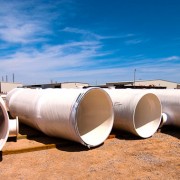
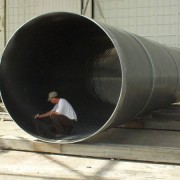
 It has always been our contention that all FRP composite pipe for fluid service should have an internal corrosion barrier/liner. Therefore, it has been our policy to supply all pipe, with such a corrosion barrier/liner. The type and thickness of this corrosion barrier/liner will depend upon the specific service environment. The thickness of a corrosion barrier/liner can range from a 40 mil (0.040″) for cooling water applications, to over 200 mil (0.200″) SPI type for wet chlorine gas service.
The purpose of this blog post series is to detail why we believe it is important to provide FRP composite pipe with an internal corrosion barrier/liner.
We will take each major reason and discuss in each blog post.
The first major reason to use lined FRP pipe is Corrosion Resistance.
We realize that some pipe manufacturers market a pipe without a corrosion barrier/liner (typically called unlined pipe). Interestingly, in most cases, the resins used for the unlined pipe series also have lower corrosion resistance capabilities, and lower service temperature limitations. All pipe manufacturers provide a corrosion barrier/liner in their pipe intended for moderate to severe corrosive applications.
Since fiberglass reinforced composite pipe is typically used for applications where corrosion is a consideration, it seems only logical to use a corrosion resistant product. In FRP composite pipe, the resin matrix provides the corrosion resistance. The higher the resin content of the laminate exposed to the service environment, the “better” the corrosion resistance. Also, within the limits of the resin system, the thicker the corrosion barrier/liner, the greater the corrosion resistance.
Unlined pipe typically has a resin content of just 30 to 40 percent in the surface exposed to the service environment. In pipe built with a corrosion barrier/liner, the resin content is typically 80 to 90 percent.
What does all this mean to the end user? In a filament wound composite pipe, the cost of adding a corrosion barrier/liner is not all that great in comparison to the true cost of the pipe. The selection of the proper type and thickness of the corrosion barrier/liner can more than double the service life of the pipe. Since fiberglass pipe is typically being bought to provide longer service life than other alternate materials, the addition of a corrosion barrier/liner can become an important cost savings to the end user, providing the lowest cost per year of service life.
Contact us today and we can arrange a test installation in your plant comparing Beetle Plastics abrasion resistant composite pipe with your current piping and duct materials.