How is Fiberglass Reinforced Plastic Fabricated?
 In this post, the second of our FRP blog post series, we’re going to cover three of the most common fabrication methods for fiberglass reinforced plastic. The first of which is the most basic:
Hand Lay-Up
This is the most basic of fabrication techniques for fiber-glass-reinforced plastics. Sometimes, it is also referred to as “contact molding.” A simple mold, whether male or female, is used. It is first coated with an appropriate release agent and the layup fabrication is started. The first material applied is normally a 10-mil layer of resin and special corrosion resistant glass called “C-glass”. This reinforcing glass is in the form of a very thin veil or surfacing mat, similar in appearance to the “angel hair” used for Christmas decorations. This first 10-mil layer gives a high-resin, low glass content corrosion barrier.
In the hand-lay-up process, this 10 mil layer is followed by a minimum of two layers of fiberglass in a mat form. This mat consists of chopped glass fibers, randomly oriented, with a binder that holds them into a coarse cloth like form that can be cut, handled and applied. Resin, catalyzed to cure at a predetermined rate, is applied by means of brush or spray gun. The resin is worked into the chopped-glass mat by means of rollers, similar to paint rollers.
When the wall thicknesses are ¼ inch or more, (typically, when past the first two layers of chopped mat), a stronger glass reinforcement is used. This reinforcement is known in the trade as “woven roven,” and consists of continuous glass filament woven in a pattern similar to a coarse cloth. The woven roving reinforcement and chopped mat are put in alternate layers, with the final layer being chopped mat.
Spray Up
This is very similar to hand lay-up, and is also included in the general category of “contact molded” fabrication. Spray up is simply an automated way of depositing the chopped glass. Fabrication still starts with the 10 mils of surfacing vein glass in a continuous fiber form, similar to a thin rope. It is pulled through a gun head that chops it into short lengths and sprays it toward the mold. At the same time, catalyst and resin are sprayed through the gun head. Thus, the catalyst, resin and glass are all deposited at one time. The resulting spray lay-up is rolled to obtain good wet-out of the glass and to remove any entrained or entrapped air. Savings come from a reduction of labor and the use of a lower cost form of glass reinforcement. For heavier laminates, woven roving is still used between alternate layers of chopped glass laminate.
Filament Winding
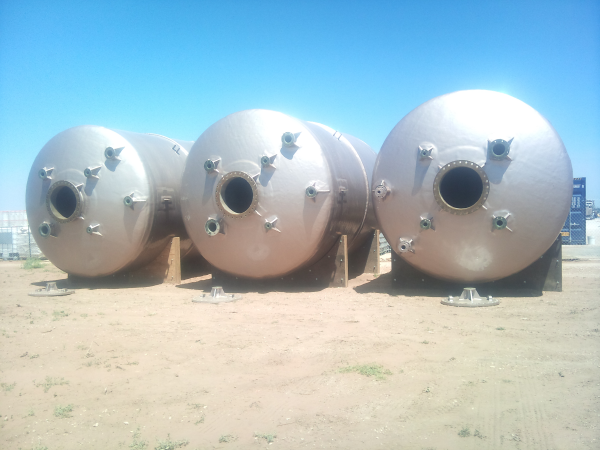
In this fabrication method, which is primarily applicable to round or cylindrical parts continuous glass fiber, again in the form of a very thin rope, are pulled through a bath of catalyzed resin. In the bath, the glass fibers are thoroughly wetted and the excess resin removed. The resin-impregnated fibers are then wrapped around a rotating mandrel. Typically, this is mounted in a winding machine resembling a lathe. The glass fibers traverse the length of the rotating mandrel, laying the fibers in a predetermined pattern. Typical products that are produced by filament winding include frp pipe of various sizes and large diameter tanks. Depending upon the application, fabrication of the part will start with a number of layers of high-resin-content “C-glass” surfacing mat (usually 20 to 60 mils total), followed by approximately 100 mils of the randomly dispersed chopped fibers, and then followed by the filament winding.
Are There Other Fabrication Options?
Yes, in addition to hand lay-up, spray up, and filament winding there are three other fabrication options; pultrusion, press molding, and centrifugal casting. To learn more about these fiberglass reinforced plastic fabrication techniques, please download our free brochure, “Fiberglass Reinforced Plastics for Corrosion Resistance.”